Monthly Archives: May 2013

Molyneux’s Curiosity Game: why did anyone play?

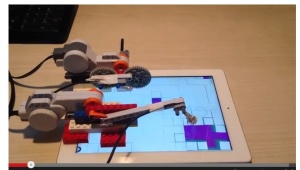
Now that game auteur Peter Molyneux‘s massively mobile cube clicking game, Robot playing CuriosityCuriosity -What’s Inside the Cube?, is over we are left to puzzle over its odd success.  The gameplay was so mindlessly repetitive that it could be performed by a simple robotAnd yet millions of people downloaded it to their iPhones and iPads and clicked away at billions of pixelated squares, and 30,000  of them were still at it almost six months after the release date when the game came to an end last Sunday.  What would make a human do it?  I think there were 4 main motivators. Continue reading

Arrested Development’s Major Meet-Ups

Serial TV dramas (daytime soap operas, prime time drama) have long used the convention of the Major Meet-Up — a party,  holiday gathering, public announcement, wedding, funeral, or  some other staged event with a set time and place — to bring together multiple characters and multiple story threads for some heightened dramatic encounters.

The Netflix-based Season 4 of  the dysfunctional family sitcom Arrested Development, which I have already described as an example of a Multiple Point of View Replay Story makes significant use of this technique  with such classic dramatic Meet-Up situations such as Continue reading

Arrested Development as Multiple POV Replay Story

I have the same blouse

I have the same blouse! (It is her blouse on that gay activist protestor, and it is also her husband wearing it, thinking he is going to a pirate-themed party.)

After a seven year absence, the cult comedy hit Arrested Development released a 4th season this week, not as a network TV show like the first 3, but as a Netflix series. The first three seasons inspired obsessive fan attention  in part because of many subtle sight gags and references to minutiae of earlier episodes.  It was a good match for the switch from the time-shifting of the analog VCR era to the freeze-frame,  instant replay, and season-binging of the digital era of DVRs and DVDs, as  the creator Mitchell Hurwitz commented on at the time: “In a funny way we feel like we’re making a show for the new technology” of TiVO and DVDs  (from Fresh Air  2005 interview as quoted  by Farhad Manjoo in Slate).

The new season  is equally influenced by its new Netflix platform which differs from broadcast/cable models in offering simultaneous release of all 15 episodes.  This platform constraint was reinforced by the very different production environment which brought the full cast  together for only a few days. Hurwitz responded by experimenting with the episodic narrative structure, focusing each installment around a single character, while creating many intersecting scenes that occur in multiple instantiations, changing their meaning when seen from different points of view.  

In other words, he saw the new season as a potential  Replay Story, of the Multiple Points of View variety. Although he did not use those terms to describe it, he did underline the special potential of the digital platform for a different kind of narrative structure. From the Slate article:

Because the entire season would be going up at the same time, he [Hurwitz] toyed with making the episodes unordered, letting audiences choose how to watch. But he eventually went back on that plan. Instead, all the events in the season are occurring concurrently, and you’ll sometimes see the same scene in different episodes from different perspectives.

In the conference call, he explained that ideally viewers would be able to jump from one episode to another at the push of a button when that happens. But once again, he’s ahead of his time: “We have things in the show that the technology isn’t quite able to handle, just like we did in the first show,” he said during the press call.

Although I tend to agree with the reviewers who find this new season less focused and satisfying than the best of the original episodes, I also think that Hurwitz’s inventiveness in structuring these interconnected stories makes it a milestone in the evolution of  digital narrative formats, building on but going well beyond the easter egg pleasures of the original series. I will be offering some examples in later posts.

Replay Story Structure: Life After Life (2)

Following on previous posts on the replay structure of Kate Atkinson’s 2013 novel Life After Life  and on Design Strategies  for Replay Stories,  here is a closer look at how Atkinson  presents the many alternate versions of the life of her protagonist, Ursula Todd (note that her last name is a pun on tod,  the German word for dead — appropriately for a character who dies repeatedly throughout the book).

LAL Partial Contents 1910 to 1926

Part of the Table of Contents , taken from the Kindle edition as displayed on an iPad.

Continue reading

Six Key Design Strategies for Replay Stories

Replay Story: an interactive digital story structure in which the same scenario is offered for replay with significant variations based on parameters that the interactor may control or merely witness in action.

An emerging form of digital storytelling that has been widely prefigured in traditional media is the Replay Story.  Traditional examples of stories that are retold, within the same unisequential book or play, or through multiple books or plays,  can be divided into two main kinds: Continue reading

Narrative Design Example: Life After Life

Speakers at IFOG2013 last week were asking  how game designers can tap into the unrealized potential of interactive storytelling.  Computer scientists and designers often approach this question by looking at story-like game examples, like this year’s popular transmedia  game, The Walking Dead .   But it is also worth looking at it from the reverse direction  from “harbinger” artifacts  (as I call them in Hamlet on the Holodeck, i.e. books or films or theatrical plays that seem to be outgrowing the limits of traditional unisequential presentation.

For example, Kate Atkinson’s  inventive novel Life After Life (2013) in which the story  starts over again repeatedly like a videogame. By the end of the book, the reader has been offered  so many variants on the protagonist Ursula’s life that you would need   a flowchart like the one below to describe them.

Poor Ursula struggles through a perilous childhood followed by the dangers of World War II in Europe.  Her life is filled with the kind of life events that make us wonder what if things had gone differently.  It is unusual for a mainstream novel to invite us to indulge in  this kind of “what if” thinking, and to use multiple versions of the same event. Atkinson’s story draws on narrative strategies from post-modern literary experimentations (like Borges’s “Garden of  Forking Paths,” or Eco’s If on a winter’s night a traveller) and from science fiction parables (like Bradbury’s “A Sound of Thunder”  or LeGuin’s Lathe of Heaven).  But unlike these earlier works, the novel does not focus us on the subversion of narrative conventions or the mechanics of alternate timelines.  Instead, it uses the notion of alternate versions of the same life to explore what life means to a particular woman living through a very realistically and specifically rendered historical time.

LIfe After Life Flow Chart v3

Life After Life therefore seems to me to be a significant harbinger of an emerging interactive narrative genre — the Replay Story — that I have been predicting and assigning to my students for some time now.  Here is a draft definition:

Replay Story: an interactive digital story structure in which the same scenario is offered for replay with significant variations based on parameters that the interactor may control or merely witness in action.

Replay stories are characterized by complex causality and exploration of chance, and they gain coherence by offering clear parallels juxtaposed with dramatic contrasts.  I’ll have more to say about this genre in future posts.

Note: updated with revised flowchart (version 3) to include more detail and corrected attribution for Bradbury.
An example of gamification that isn’t bullshit

With his customary understatement, my Georgia Tech colleague Ian Bogost has famously pointed out that Gamification is Bullshit,  or more precisely “marketing bullshit” whose purpose is “to capture the wild, coveted beast that is videogames and to domesticate it for use in the grey, hopeless wasteland of big business.”  I know what he means and I am also often skeptical of the more benevolent arguments for “gamification,” such Jane McGonigal’s heartfelt argument that games are the best way to ensure human survival in the next century.   What McGonigal ignores is that human culture is already completely gamified – how else to explain the deep pleasure in synchronizing our behavior with one another, in finding symbolic meaning in arbitrary symbols like vocalized sound and scratches in stone? We are hard-wired to enjoy all the things that make up games and we have already used all of those pleasure-producing and obsession-engendering mechanics to shape everything from language to tax codes to  traffic lights to war strategies. For good or bad, the world is already profoundly gamified — so we had better pay attention to the hands we have already been dealt. Continue reading

Is cat poop the same kind of medium as videogames?

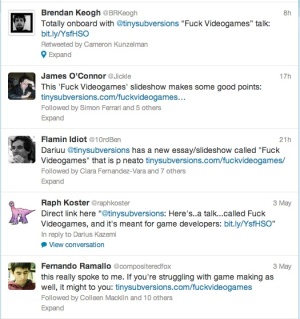
There has been a lot of twitter chatter this week about an endearing rant by Darius Kazemi with the arresting title of Fuck Videogames aimed at encouraging frustrated game designers to embrace other forms of creative expression.
fkvideogames

Clearly this is a timely message, and probably a mark of the success that this active community of practice has  had in encouraging creative expression in videogames.

I don’t quarrel with Kazemi’s main point — and in fact I’ve often said that there is no hierarchy of media. No individual book, for example, is more valuable than any individual game (or film or TV show) just because it is expressed in lengthy text passages instead of interactive bits or moving images.   But Kazemi isn’t talking about books or films. He is talking gelato and cat poop — which I do indeed have a problem with.

Continue reading