Simulating Heroism

Earlier this semester one of my students showed a Sony Playstation promotional video called Michael  in which characters from multiple videogames gather in a bar. A Globe and Mail column describes the scene like this:

“Michael” is a two-minute live-action film featuring characters from more than a dozen games that have appeared on PlayStation platforms. It begins with a pair of Second World War soldiers from Call of Duty parachuting through the night into a forest. The duo make their way through the shadows to a dimly lit pub, where they find PlayStation-exclusive heroes including God of War’s Kratos, Uncharted’s Nathan Drake, and LittleBigPlanet’s Sack Boy mingling with personalities from popular multiplatform franchises including PortalAssassin’s Creed, and Metal Gear Solid. Continue reading
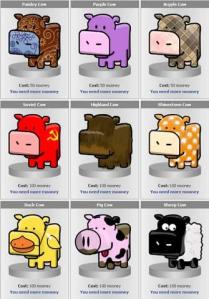
The Elusive Writerly Cow

A recent  NPR Interview  with my colleague the game designer and theorist Ian Bogost endearingly focused on his frustration at having accidentally made an enjoyable game.

The Facebook game Cow Clicker was meant to parody Zynga's Farmville and expose its inanity and cynical commercialism. Instead it became a hit.

Cow Clicker was  meant to parody  the wildly successful Facebook game Farmville,  exposing its unchallenging and pointless gameplay and its cynical commercialism. But  to Bogost’s dismay his intentionally boring game unexpectedly attracted 50,000 users.  Stunned out of his customary ironic detachment, Bogost found himself unable to resist the direct “pleasure” of having people play his game.  He began to pay attention to what they liked and to fulfill their requests, though he was bothered by their unironic pleasure in the gameplay. In order to reinforce his satiric intent, Bogost  tried to subvert the game by charging ridiculous amounts of money for obviously worthless virtual items. To his dismay, people paid and continued to enjoy the game.   Eventually he resorted to outright destruction, starting a counter that ended with a satisfyingly absurd “rapture” that left no cows standing, just a little clickable shadow in the pasture: a “cowpocalypse”!

Continue reading

Transcending Transmedia Part 2

In a  previous post I described “transmedia storytelling” as an interim term for an additive strategy  of  creating a consistent fictional world across multiple legacy media platforms, like TV and videogames.  I expressed an expectation that we will see a unified new genre of storytelling native to the new digital medium, as I described in a previous book.

The SyFy TV show Defiance will have an associated MMO set in a different city within the same storyworld.

What would this new participatory story genre look like? Some of its conventions are clear, based on the way people have wanted to connect with existing story worlds and multiplayer games: It will involve an internally consistent but puzzling fictional world, an authored but participatory plot, and an encyclopedically large cast built around a small number of iconic figures. Continue reading

Transcending Transmedia Part 1

Every week there is a new announcement of “How transmedia storytelling is changing TV” . This week it is parallel TV and web contests on Bravo’s Top Chef.

Entertainment is a risky business, so anything that makes money or attracts attention becomes the basis of the next pitch and the next big investment. After the success of Lost in spreading fan involvement from the TV screen to the web in the form of intense plot speculation, map-making, webisodes, and games, “transmedia storytelling” — whose properties have been brilliantly observed by my old friend and colleague Henry Jenkins of USC — became the goal of many producers. I agree with Henry that the creation of a consistent story world with participatory elements that takes viewers deeper into the fictional universe is a phenomenon that is very much worth taking note of.  But I am also impatient with the concept, because I don’t expect “transmedia” anything to be around very long.

Continue reading

The Future of TV

Earlier this year a research group at Cisco interviewed people in TV and academia (including me) and came up with 10 useful predictions about the future of tv. One of the authors of the report, Bill Gerhardt, will be on a panel I am moderating at FutureMediaFest this Wednesday November 16 at 2:45.

Continue reading

Who is “YOU”? Person – Player – Character


Who is the "You" being addressed in this game?

Continue reading

Mapping the Beat

This semester I am teaching interactive narrative again and we spend a great deal of time thinking about dramatic beats.  

Our friends at the Stupid Fun Club have helped out by letting my students use StoryMaker the authoring system they developed for the crowd-sourced Current TV show, Bar Karma.This  screen shot shows how StoryMaker lets one or more authors make up alternate versions of the same beat and link them along alternate paths. Unfortunately for us, the system is meant to produce unisequential TV shows rather than multisequential interactive narratives, so we can’t build our stories in it. But it is still very useful because it imposes an organization of multiple parallel dramatic beats (the columns) capable of being linked by  multiple intersecting paths.

Amazon is now a … Library?

Amazon has just announced that it will lend electronic books to Kindle owners as well as sell them. This comes on the heels of their announcement of increased publishing deals with authors. So are they a bookstore, a publisher, or a library?  Continue reading

Lord of Lisp

While digital culture around the world was mourning the untimely death of Steve Jobs this month, another  towering innovator slipped away unnoticed. John McCarthy’s, who deserved the “genius” designation at least as much as Jobs did, was a professor at MIT  in the 1950s when he invented the now obscure LISt Processing programming language (LISP), which laid the conceptual basis for the representational power of computation as we know it today. 

Continue reading

Siri as Pretty Good Companion

In Inventing the Medium  I devote a chapter to the Companion Model as one way of scripting the interactor. I talk about the recurring fantasy of the computer as a perfect mind-reading servant.  Siri, the voice-activated app on the iPhone, is the most ambitious attempt so far at creating a servant companion and its successes and failures illustrate the principles in this chapter.
Continue reading